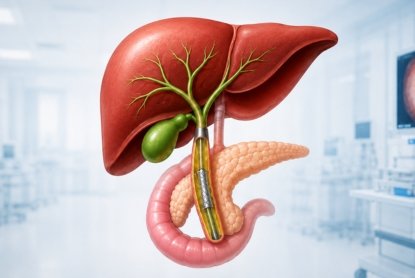
When his symptoms recurred, the patient consulted Dr. Vikas Singla. After detailed evaluation, an MRCP scan was performed, which revealed:
Based on these findings, the patient was admitted to the hospital for further management.
The patient was prepared for an ERCP procedure under Monitored Anesthesia Care (MAC). Prior to the procedure, antibiotics and IV fluids were administered to reduce the risk of infection and pancreatitis.
During the procedure:
Because the stricture was quite tight, complete removal of the stone was not possible at that time, so it was decided that this would be completed in a subsequent session.
The patient remained stable, and no immediate complications were noted. The further course of treatment includes:
During the procedure:
A further ERCP session to remove the stone proximal to the anastomotic stricture, subsequently
Regular monitoring of liver function tests
A stricture at the surgical junction site is a well-recognized complication following liver transplant (particularly with living donor transplants), occurring in approximately 5–15% of cases. It typically develops a year or more after transplant and often requires multiple treatment sessions to resolve. Timely evaluation, regular stent surveillance, and consistent follow-up play an important role in managing such cases.
Disclaimer: This article has been written solely for general informational purposes and to explain the patient’s treatment process. It does not guarantee any specific treatment outcome and is not a substitute for professional medical advice. Please consult a qualified physician for personal medical concerns. The patient’s identity has not been disclosed in order to protect confidentiality