Difficulty in swallowing food or even drinking water or anything is a common problem seen in many patients visiting the OPD. This medical condition is known as dysphagia. It should never be ignored, as it can be a sign of various underlying health issues involving the mouth, throat, food pipe (esophagus), or nervous system.
When we eat food, the process of swallowing happens in several steps:
If there is a problem at any stage mouth, throat, muscles, or food pipe swallowing can become difficult.
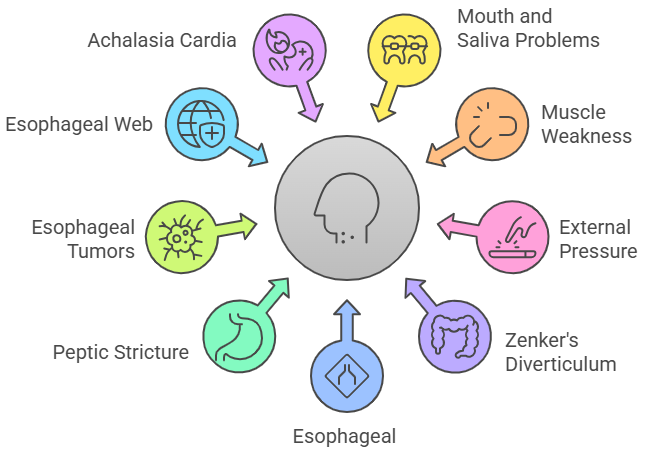
People with weak or missing teeth may not chew food properly. Similarly, patients with low saliva production such as those who have undergone radiotherapy or suffer from Sjogren’s syndrome often find swallowing difficult.
Certain medical conditions weaken the swallowing muscles, including:
These conditions reduce muscle strength, making it difficult to push food down.
Sometimes, structures outside the food pipe can press on it, causing dysphagia. Examples include:
In such cases, investigations like a CT scan are required.
Some patients experience difficulty swallowing along with food regurgitation or abnormal throat sounds. This may be due to Zenker’s diverticulum, a pouch formed in the food pipe. Food collects in this pouch and compresses the esophagus. Treatment involves cutting the septum endoscopically, which relieves symptoms effectively.
Esophageal strictures can occur due to:
These strictures are diagnosed using endoscopy and are usually treated by widening the food pipe using dilators or balloons. Surgery may be required in severe cases.
Patients with long-standing heartburn (GERD) may develop wounds in the food pipe due to acid reflux. When these wounds heal, they form scars that narrow the esophagus, known as peptic stricture. Balloon dilation during endoscopy is an effective treatment.
Difficulty in swallowing that gradually worsens starting with solid food and later affecting liquids along with weight loss and reduced appetite, may indicate an esophageal tumor. Diagnosis is done through endoscopy and biopsy.
Some patients have a thin membrane in the food pipe called an esophageal web. This condition is often associated with wheat allergy or low hemoglobin levels. It can be easily diagnosed and treated using endoscopy.
Achalasia cardia is a condition where:
This leads to difficulty in swallowing food.
If you experience difficulty in swallowing food or water, do not ignore it. Early diagnosis helps in effective treatment and prevents complications.
Dysphagia is a treatable condition in most cases. With proper investigation and timely treatment, patients can regain normal swallowing and improve their quality of life.
If you or your loved ones are facing difficulty in swallowing, consult a gastroenterologist at the earliest.